Most writers have heard of the Bechdel Test. Fewer have heard of the DuVernay Test, the Smurfette Principle, or the Sexy Lamp Test. But these and other “representation tests” can be valuable tools for developing and evaluating creative projects.
This article grew out of a recent MusicalWriters.com Office Hours discussion. (Our members and team meet virtually several times a month). Member Jodie Fox mentioned a “Sexy Lamp Test,” which resulted in some immediate follow-up questions and Googling. Special thanks to Jodie for sharing her personal collection of representation checks, which became the foundation of this article. (Follow her on Instagram at @velvetcurtainmusical)
“I learned a few years ago about the Bechdel Test from the Isabel Pless song, Bechdel Test,” Fox explained. “It got me curious, so I researched it and began holding my writing accountable – how many scenes could I write that passed? Then I discovered more tests out there.”
She went on to write, “I’ve found [these tests] incredibly helpful for developing characters.” Fox is right to frame them this way: as a collection of audits and lenses to improve one’s creative work.
A few important disclaimers
Before we get into the list, a few things are worth noting.
First: your musical does not need to pass every test here.
Second: passing a test does not automatically mean your representation is strong.
Third: failing a test does not automatically mean your script is shallow, offensive, or broken.
Some shows fail a test accidentally. Some fail deliberately because of genre, satire, historical setting, or point of view. Some may pass easily while still giving us thin or stereotyped characters.
The point of these tests is not to win, or earn a “passing grade.” The point is the process and the curiosity it fosters.
The best-known representation test: The Bechdel Test
The Bechdel Test is familiar to most writers. A work passes if it has:
- at least two women
- who talk to each other
- about something other than a man
Alison Bechdel, on whose work the Broadway musical Fun Home was based, published the following set of panels in 1986, in her comic strip Dykes to Watch Out For.
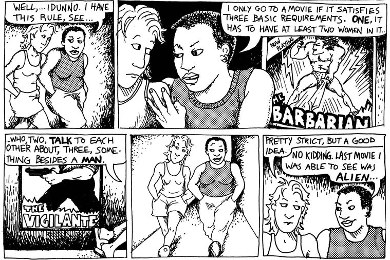
A character in “Dykes to Watch Out For” explains the rules that later came to be known as the Bechdel Test (1985). Source: Wikipedia
What makes the Bechdel Test so effective? Perhaps because of the low standard it sets. A creative work can pass the test and still have weak, underwritten female characters. The bar is—quite honestly—low, by design. The Bechdel Test conversation reveals how often women exist in a story only in relation to men.
For musical writers: do your women speak (or sing) to each other about work, ambition, art, fear, money, politics, grief, food, dreams, weather… anything? Or is their stage time primarily spent in orbit around, say, a handsome tenor?
To go further, musical writers can look beyond dialogue alone. Who gets the big solos or duets, conveying a rich inner life? Who drives the action rather than reacting to it? A musical may pass the Bechdel Test and still leave its women in the wings of the story. On the other hand, it may technically fail the Bechdel Test and succeed in sharing female characters with a rich inner life and narrative importance.
Other Gender-based Tests
The Bechdel Test opened the door for other gender-based tests of creative representation. These newer tests look beyond dialogue to things like agency, tokenism, and story structure.
The Reverse Bechdel Test
The Reverse Bechdel Test gender-swaps the Bechdel Test structure. To pass, a script must include:
- at least two men
- who talk to each other
- about something other than a woman
Let’s be honest: most musicals pass this one with one baritone tied behind their back.
Looking beyond dialogue: The Mako Mori Test
Works that fail the Bechdel Test based on dialogue may still contain complex female characters. This gap inspired our next female-focused representation test: the Mako Mori Test.
Inspired by the character of the same name from the film Pacific Rim, the Mako Mori Test asks whether a work contains:
- at least one female character
- with her own narrative arc
- that does not exist solely to support a man’s story
When one character has to stand for “everyone”: The Smurfette Principle
Cultural critic Katha Pollitt named the Smurfette Principle to describe a common cast imbalance: one woman in a sea of men. This lone “different” character often ends up carrying the burden of representing an entire demographic. They are the one marginalized character in a group otherwise treated as the default.
Once you know the Smurfette Principle, you start noticing it everywhere. Beyond Smurfette in The Smurfs, the list includes:
- Katherine Plumber in Newsies
- Mary Magdalene in Jesus Christ Superstar
- Black Widow in the Avengers
- Penny in Big Bang Theory
Perhaps the most memorable name of all: The Sexy Lamp Test
Marvel Comic writer Kelly Sue DeConnick, the creator of the comic series Captain Marvel (with protagonist Carol Danvers), describes her Sexy Lamp Test: “If you can remove a female character from your plot and replace her with a sexy lamp and your story still works, you’re a hack.”
(Content warning: DeConnick uses slightly more, um… intense language in the Comic-Con clip below.)
The Sexy Lamp Test is especially relevant in theatre, where producers’ costs are often determined by the number of humans involved. Why pay for an actress when you can just find a sexy lamp? Every character—especially those from underrepresented groups—should earn their stage time and their paycheck.
MusicalWriters.com suggests: The Lowrey Lens
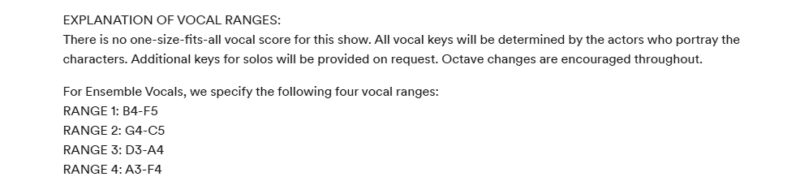
No widely recognized representation test yet focuses on characters outside the gender binary. (See the Vito Russo Test in the next section for the closest established framework.) This gap feels especially relevant to musical theatre, where a character’s gender can be shaped by vocal writing, along with dialogue and character description. A role might read as unintentionally “gendered,” simply because it is published in the original performer’s key.
Given that gap—and MusicalWriters.com’s commitment to uplifting and protecting trans and nonbinary artists—we’d like to propose an additional guideline.
Inspired by Rebecca Lowrey’s article, “Breaking the Binary: Rewriting Theater’s Gender Narrative,” we propose The Lowrey Lens. These questions help determine if a show genuinely makes room for trans and nonbinary humanity, both on the page and in performance.
A musical honors The Lowrey Lens if it:
- includes trans or nonbinary characters as full people, not symbols or token gestures
- gives those characters importance in the narrative
- leaves flexibility, where appropriate, in casting language, vocal range, or musical key
- considers the experience and safety of the performers themselves
For an excellent example of a Lowrey Lens musical, check out the Cast List documentation for the Kerrigan and Lowdermilk musical Ernxst.
LGBTQ+ Representation: The Vito Russo Test
The “Vito Russo Test” takes its name from Vito Russo, co-founder of GLAAD and author of the 1987 book The Celluloid Closet. The Vito Russo Test asks whether a work includes:
- an identifiable LGBTQ+ character
- who is not solely or predominantly defined by their sexuality or gender identity
- and whose removal would have a significant effect on the plot
Even though the test was officially created by GLAAD to evaluate movies, if we apply its lens to theatre, we can find many “passing” examples. In musicals such as Fun Home, The Prom, Falsettos, A Strange Loop, A New Brain, and Hedwig and the Angry Inch, as well as plays like Torch Song Trilogy and Angels in America, LGBTQ+ characters are central to their stories’ emotional and structural life.
GLAAD itself stresses, however, that passing this test is just the first step. Writers interested in exceeding the Vito Russo Test’s baseline can study both craft resources and queer-authored work. GLAAD’s Media Reference Guide and Guide for LGBTQ Inclusion in Entertainment are strong starting points for writers creating LGBTQ+ characters.
Race and interior life: The DuVernay Test
Named for Black film director Ava DuVernay, the DuVernay Test requires:
- a story featuring characters of color
- with names
- who have dialogue and story lines independent of white characters
New York Times film critic Manohla Dargis coined the term in a 2016 article heralding the Sundance Film Festival as a setting “where numerous selections pass the Bechdel test and, in honor of the director and Sundance alumna Ava DuVernay, what might be called the DuVernay test, in which African-Americans and other minorities have fully realized lives rather than serve as scenery in white stories.”
Across all these tests, the goal is the same: that the arts should create a diverse cast of characters that reflect the human experience, without forcing any one character to stand in for an entire group.
To go further, writers can study equity-centered storytelling resources, such as the Sundance Institute’s Inclusion Resource Map and Anti-Racist and Structural Equity Resource Guide.
Extending the Model
Writers can—and should—apply the principles of the DuVernay Test to other races and cultural groups, paying specific attention to challenges faced by each population. When possible, writers should consult directly with people who bring lived experience to the characters in question. This could include anything from an informal conversation to a professional sensitivity reading.
The Smurfette Principle applies equally to race and ethnicity—anywhere a single character is left to represent an entire group. Writers and critics have also proposed tests focused on particular populations, including the Riz Test and the Ali Nahdee Test.
The Riz Test
The Riz Test includes five criteria to measure how Muslims are portrayed on film and TV. It was inspired by Riz Ahmed’s 2017 speech about diversity on screen.
The test states:
If the film/show stars at least one character who is identifiably Muslim (by ethnicity, language, or clothing) is the character…
- talking about, the victim of, or the perpetrator of terrorism?
- presented as irrationally angry?
- presented as superstitious, culturally backwards, or anti-modern?
- presented as a threat to a Western way of life?
- (for male characters) presented as misogynistic? Is she (if female) presented as oppressed by her male counterparts?
If the answer for any of the above is yes, the work fails the Riz Test.
The Ali Nahdee Test
Creator Ali Nahdee developed the test from her desire for change in how Indigenous women are portrayed in media.
In order to pass the Ali Nahdee Test—originally known as the Aila Test (named for the character in Rhymes for Young Ghouls) a story must have:
- an Indigenous woman who is a main character…
- This includes any existing Indigenous group as well as fictional Indigenous-coded characters
- This includes trans women/femmes
- Must be portrayed by an Indigenous actress if the story is live action
- …who does not fall in love with a white man…
- Love and sex are not the same thing
- Can fall in love with a white woman/Enby
- …who isn’t raped and does not die at any point in the story
- This includes before and after the events of the narrative.
The specific language of both of these tests does something useful: it names stereotypes, making them harder to ignore. For more suggestions about incorporating diversity in your character descriptions, check out this online workshop with MusicalWriters.com CEO Rebecca Lowrey: Character Descriptions and Cast Needs.
Disability Representation: The Fries Test
Writer and editor Kenny Fries created this test for a teacher preparing a class on writing and empathy. The Fries Test looks for:
- more than one disabled character
- disabled characters with narrative purposes beyond educating or benefiting a nondisabled character
- disabilities that are not erased by cure or death
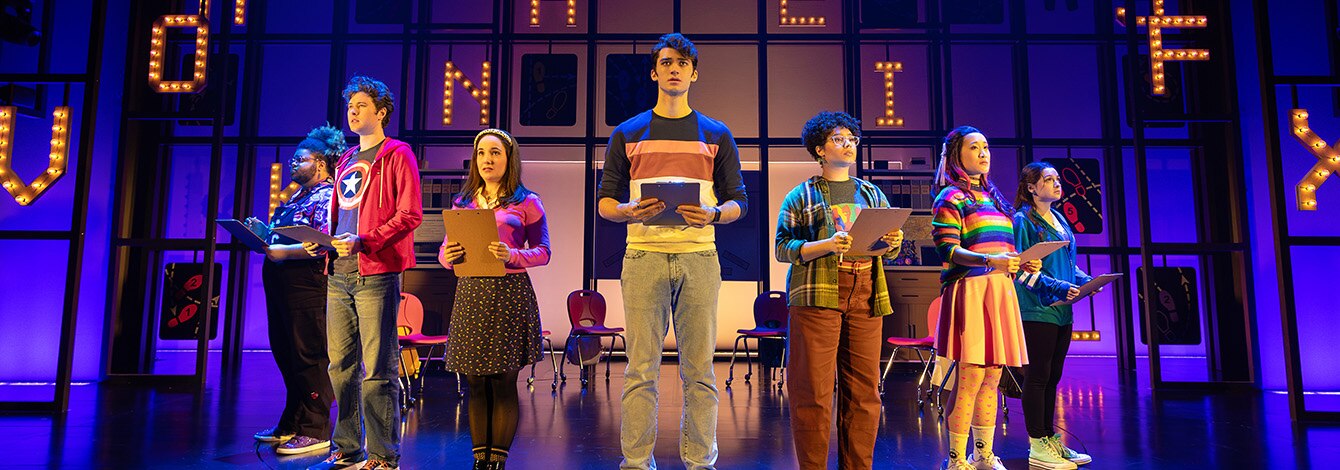
Recent Broadway Musical “How to Dance in Ohio” shined a theatrical spotlight on a group of autistic characters and performers.
Few musicals pass the Fries test. The recent Broadway musical How to Dance in Ohio by Jacob Yandura and Rebekah Greer Melocik is one of the clearest examples. In straight plays, works like Cost of Living by Martyna Majok and Teenage Dick by Mike Lew come close, as they include more than one disabled character with real narrative purpose.
It is worth noting, though, that even when a musical’s script does not pass the Fries Test, productions can still make meaningful room for disabled performers. Deaf West Theatre, for example, has built a body of work that bridges Deaf and hearing communities through revivals like Spring Awakening and Big River utilizing both ASL and spoken English. These productions don’t change what’s on the page, but they prove that staging can expand access and create richer possibilities for disabled musical theatre artists.
To go further, writers can seek out disability-led resources such as the NCDJ Disability Language Style Guide or resources from RespectAbility’s Entertainment and News Media team.
The Ultimate Test: An Audience
Passing a representation test on paper is one thing; gathering feedback from a live, diverse audience is quite another. A table reading or staged reading will reveal how your characters land with a live audience.
These readings can happen in your own community, or—for even more insight—a different location entirely. Several writers have sought out MusicalWriters.com readings specifically because of our Dallas location. They were interested in knowing how the show resonated with a non-NYC audience. Choosing your reading location based on the audience feedback you need can itself be a meaningful test.
Taking the Next Steps
So, how might writers actually apply this collection of representation tests to their own projects?
It’s tempting to treat these assessments as a simple rubric, rather than a prompt for deeper thinking. But writers focused on “ticking boxes” might miss the richer storytelling these tests can unlock.
Instead, remember the way our member Jodie Fox first described using these tests: as tools for accountability, curiosity, and character development. And a way to spot – and rewrite – any “sexy lamps” that you may discover.
If one of these tests does reveal a gap in your script, don’t panic. Don’t judge yourself harshly or abandon ship on the story.
Instead, get curious and reach out. Consider sharing your script with collaborators or colleagues who will notice things you haven’t. (Shout out to the MusicalWriters.com Online Writers Groups!) You may also want to invest in professional feedback.
MusicalWriters.com is here to help!
Many writers bring in a dramaturg, script consultant, or sensitivity reader to help them examine the representation in their project. Sensitivity readers in particular often respond from a specific lived experience, while dramaturgs look at how the whole narrative is functioning on the page and in performance. The goal when utilizing these kinds of professionals is not to receive a “stamp of approval.” It is to get valuable feedback … while there is still time to revise.
In addition to the Dallas Table Reads and Staged Readings, mentioned above, MusicalWriters.com offers a full script coverage and consultation, which includes written feedback and a live dramaturg consultation, and one-on-one professional coaching, including a video chat with a member of our team. These consultations and coaching calls can focus on a variety of topics, including script diversity and representation.
Final Thoughts
“You can’t write a musical with only one brain” is something we believe deeply at MusicalWriters.com. It takes humans of all kinds not only to perform musical theatre, but to shape it. Representation tests, such as the Bechdel Test, the DuVernay Test, the Fries Test, and The Lowrey Lens, are not be-all-end-all metrics. But as part of an ecosystem of curiosity and care, they can be tools to help your script become as wonderfully, diversely human as it can be.