You’ve finally heard your musical out loud. The characters breathed, the jokes landed (or didn’t), and you’ve filled the margins with notes. Now that the adrenaline of your table read has faded, an uncomfortable question creeps in: What’s next? What is the next step I should take in my musical’s development?
The road to a table read is clear—you write, you cast, you rehearse, you read. (MusicalWriters.com even offers a done-for-you table read service, complete with professional feedback.)
But what about the development road AFTER a table read? That’s where options branch in dozens of directions. There isn’t a single “right” path, but there is a clear way to keep moving forward with purpose and confidence.
Step One: Celebrate (and Take Notes)
First things first: make sure you properly celebrate completing a HUGE step in your show’s development. Most musicals do NOT get to the table read stage; in fact, MusicalWriters.com estimates the number of new musicals that complete a table read could be less than 10%. So if have gotten to this point, your show is ahead of roughly 90% of all musicals that are currently being written.
So, make sure to pat yourself on the back and take a moment to celebrate your accomplishments!
But then… it’s time to get back to work. As soon as you can after completing your table read, take some time to WRITE DOWN your impressions, goals, and areas for improvement that you saw in your script. You may want to let all your table read feedback sit for a bit before diving back into edits and next steps, so think of this as writing a road map for your future self.
Feeling Lost Is Normal
Many writers describe the post–table read stage as disorienting. You’ve reached a major milestone, it’s true, but instead of clarity, you might feel overwhelmed by possibilities—or by a flood of feedback that doesn’t always agree.
That confusion is a sign that you’re in the next phase of development, not the end of one. A table read reveals what your show really is when it leaves your head and lives in the mouths of actors. Now the task is to digest what you’ve learned and decide what kind of step you need next.
Start by gathering your feedback into a single document or spreadsheet. Look for patterns. Are people confused about story logic? Do songs feel redundant? Are jokes landing inconsistently? Once you see the themes, choose a few key issues that—if fixed—would most improve the piece. This small focus will help you avoid endless rewriting and instead move strategically toward clarity.
If you’re unsure whether to dive straight into edits, remember: your goal isn’t to fix everything at once. It’s to reduce uncertainty about the story. The next step should answer a specific question, like “Is Act One’s pacing working?” or “Does the protagonist’s goal feel clear?” That simple framing will keep you from spinning in circles.
Pinpointing OBJECTIVE Feedback
As you sift through feedback from your table read, it’s important to look beyond the things people SAID and to the things that they DID (or didn’t do).
Some of the most useful information you’ll ever gather from a table read is purely observable. When did your audience – AND your actors – lean forward? When did they mentally check out? When did they laugh, sigh, or shuffle their papers? Those reactions tell you where the energy of your show rises or dips. They can also identify roles that could be consolidated or played by the same actor. (For example, if you notice one of the actors in your table read had a lot of sitting around and waiting between lines, that could be a clue that their part might need to be expanded or consolidated.)
One of the best tricks MusicalWriters recommends is to watch a recording of your reading with the sound off. Without the text and audience noise to distract you, you’ll see the physical rhythm of the piece: how long transitions take, where attention drops, and when performers seem engaged or lost. When you notice this in the recording, turn up the volume and make note of the point in the script.
Cues like these don’t depend on anyone’s opinion; they’re data. Combine that objective observation with your subjective notes and written feedback, and you’ll have a clearer, more balanced picture of what’s really happening in your show.
Understanding Your Options
Ok, so now you’ve tabulated and processed the feedback, and your script is better than ever. Now what? Before you can decide on your next best step, you need to know what your options are.
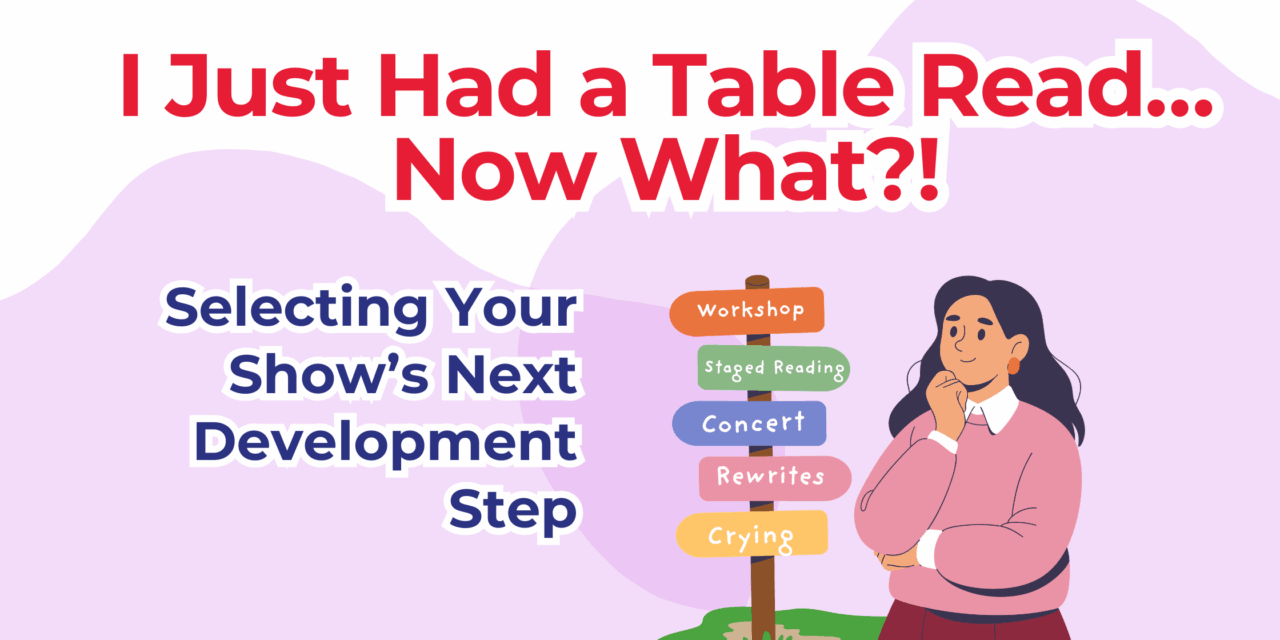
There are many valid ways to keep developing a musical after a table read, but not all are right for every stage. Below are some of the most common next steps, with guidance on when each makes sense.
Option 1: Rewrites
The most natural first step is often going back to writing. If your notes point to structural or character issues, return to the page while the feedback is fresh. This is a time for major rewrites, cuts, and reorganizing scenes or songs. Don’t rush to the next development step until you’ve made meaningful changes; otherwise, you’ll waste your readers’ time testing the same problems.
Option 2: Another Table Read
When those rewrites are complete, consider another table read—a casual, low-cost way to hear the changes aloud. The goal isn’t to impress anyone; it’s to test whether the edits achieved what you hoped. If the last table read identified pacing issues, for example, you should leave this one knowing whether that pacing improved.
MusicalWriters offers a table read service that includes professional actors and quality script feedback from producers/directors. Click HERE to learn more.
Option 3: Workshop
Once your show feels more stable, a workshop can help explore deeper questions that can’t be answered on paper. Workshops are short, focused rehearsal periods with actors and a director, often centered on one problem—like clarifying a relationship or improving transitions. They can be magical for discovery, but they’re most effective when your script is strong enough to withstand scrutiny.
Option 4: Staged Reading
After table reads (or workshops), some writers move toward a staged reading—a lightly rehearsed presentation with scripts in hand. This lets you gauge pacing, tone, and audience engagement. Think of it as a crash test for structure and flow before investing in a full production. The line between workshops and staged readings can be a blurry one, but typically a staged reading involves a performance for an audience, while workshops do not.
NOTE: MusicalWriters Members are eligible to submit to our Staged Reading Series, where several writers pitch their show for a free staged reading several times a year. Members and non-members can also apply for our Development Series which culminates in a staged reading.
Option 5: Concert Reading or Cabaret
If your music is ready but you’re not ready to stage the whole show, a concert reading or cabaret can be a smart bridge. Presenting a handful of songs in front of a live audience provides valuable musical feedback and gives you promotional material to share later. It’s also a morale boost—a reminder of what’s working musically.
For more information about staging concert readings or cabaret, check out MusicalWriters’ Ultimate Guide to Producing a Cabaret or Concert Reading in NYC.
Option 6: Recording Demos
Demo recordings are another valuable tool once your songs are stable. Clean, well-sung demos make collaboration easier and open doors to submissions and development programs. Just resist the temptation to record too early; once something is recorded, it tends to feel “finished,” even if it isn’t. You may choose to record all your songs, but you can also just choose to focus on a few key demos, for songs are fairly “locked in” and do a good job representing your show.
Option 7: Festival Submissions
Finally, many writers use this phase to explore submissions and festivals. These can provide outside perspectives, connections, and exposure—but only if your material is polished. A festival panel won’t see your “potential”; they’ll see what’s on the page today. Send only your best, most representative draft.
Option 8: Full Production
Of course, the big dream is a full production—but jumping straight there rarely serves the work. Unless you’ve been commissioned or have an opportunity with built-in funding and support, you’ll get more long-term benefit from smaller developmental steps that help you test and refine your show in stages.
Option 9: Pause
And sometimes, the right next step is to pause. Incubation—taking a break to let feedback settle—can help you see your show with fresh eyes. The danger is letting that break become indefinite, so set a return date and a small reentry goal before stepping away.
Choosing the Next Right Step
So, with all these possibilities, how do you decide on the next right step for your show? The simplest rule of thumb is this:
If a development opportunity presents itself and you feel reasonably confident you can execute it well, and it will help you answer a pressing question about your show—take it. That’s your next step.
But if no opportunity is available right now, MusicalWriters.com recommends a steady, proven sequence that balances affordability, learning, and momentum. It typically looks like this:
- Revisions – incorporate feedback (your own and others) and clarify story, character, and song function.
- Another Table Read – test your edits and pacing (especially if you made extensive changes to structure or cast needs).
- Targeted Workshop – explore specific story or character challenges or other elements like choreography or orchestrations.
- Staged Reading – hear every lyric and line of dialogue and test audience response.
- Concert or Cabaret – highlight your songs and score and gather media assets and content for social media and submissions.
- Submissions and Festivals – seek structured feedback and visibility as a marketing, development and networking step.
- Full Production – add sets, lights, choreography, props and costumes – but only when the work and resources are ready.
There is no one size fits all path. The ladder doesn’t have to be climbed in perfect order; it’s a guide, not a mandate. And certain steps may end up lumped together as one project: your workshop may culminate in a staged reading, or a festival might involve a full production. You may loop back to rewriting after a workshop or move directly to concert performances if the score is your strength. The key is to move purposefully—each step should teach you something new about your show.
Keeping Your Momentum
Writers often stall because they think they must pick the perfect next step. In truth, there’s no single “correct” move—only the next useful one. Focus on forward motion, not flawless planning.
A helpful exercise is to ask yourself two questions:
- What’s the biggest uncertainty in my show right now?
- What’s the smallest/safest/cheapest way to test that uncertainty?
Your answer will likely point straight to your next action. Maybe that’s a rewrite sprint. Maybe it’s a living-room read. Maybe it’s a small public performance. Whatever it is, the goal is to learn something new about your show—not to prove it’s already done.
Budget and time matter, too. Development can be expensive, but the most valuable steps often cost the least. A well-run table read in your own hometown or a workshop or festival performance in a city like Dallas can teach you more than a flashy and expensive staged reading in NYC . Spend strategically—on opportunities that give you lasting insight and forward progress, not fleeting validation.
Common Pitfalls
If you want to protect your energy and your show, avoid a few predictable traps.
- Don’t rush to present your piece again before you’ve made substantial revisions.
- Don’t collect endless feedback without synthesizing it into a plan.
- Don’t jump to production before testing the material with smaller audiences.
- And don’t record expensive demos before you’ve finalized keys and lyrics.
Each of these shortcuts feels like progress, but they can actually freeze your show in an unfinished state. Development is iterative by design. Each pass should make the next one more focused.
Final Thoughts
A table read isn’t the end of your writing journey—it’s the start of the show’s real life. The best thing you can do now is keep moving, one deliberate experiment at a time. Whether that means revising quietly, hosting another reading, or preparing a cabaret, choose the step that will teach you the most for the least cost.
If you need guidance, MusicalWriters.com offers resources, checklists, and community programs to support every phase of your show’s development. Wherever your next step leads, remember: your musical doesn’t grow in your head—it grows in the room.