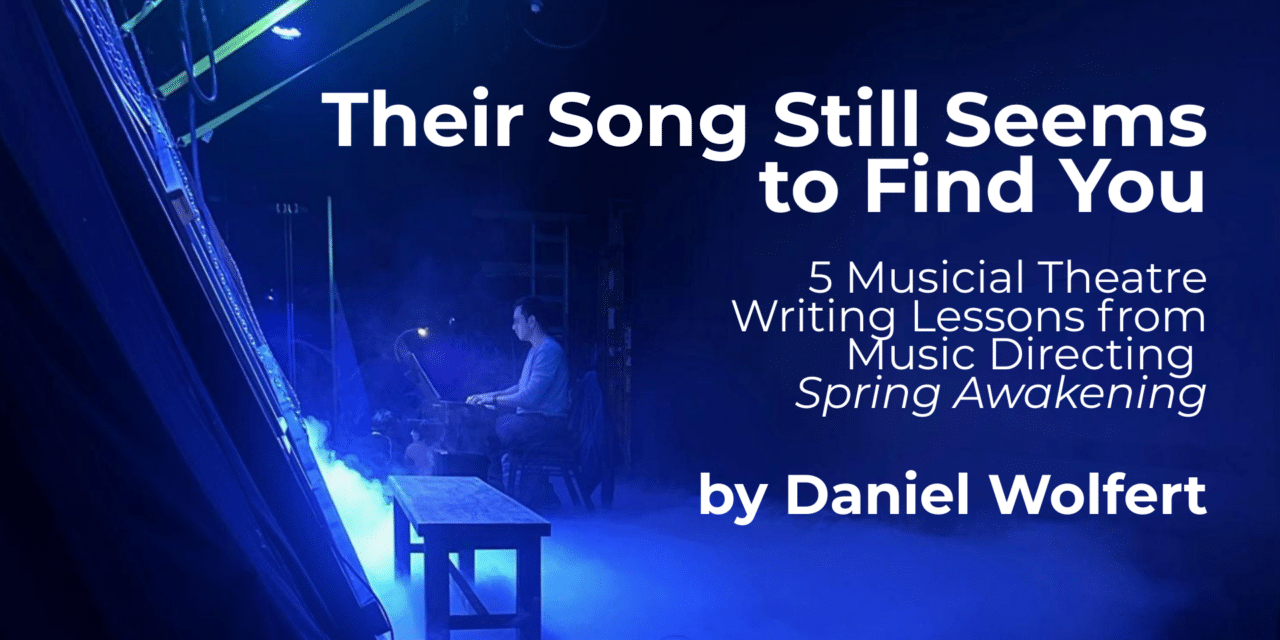
In the summer of 2025, the artistic director of Tacoma Little Theater asked me to music direct an upcoming production of the Tony Award-winning, folk/rock musical Spring Awakening. I immediately said yes – and it was not because I liked the musical.
I’d seen the musical many years before and walked away feeling like I just hadn’t understood it. But I said yes to music directing it because it was the sort of show and musical style I would never write of my own accord, and so I thought it would be an effective educational experience.
From January through March of 2026, I lived inside the show by teaching the actors their harmonies, then playing keys for 4 weekends of shows, and getting immersed in a flavor of storytelling I’d never written. Here are the 5 most important lessons that Spring Awakening taught me as a musical theater writer.
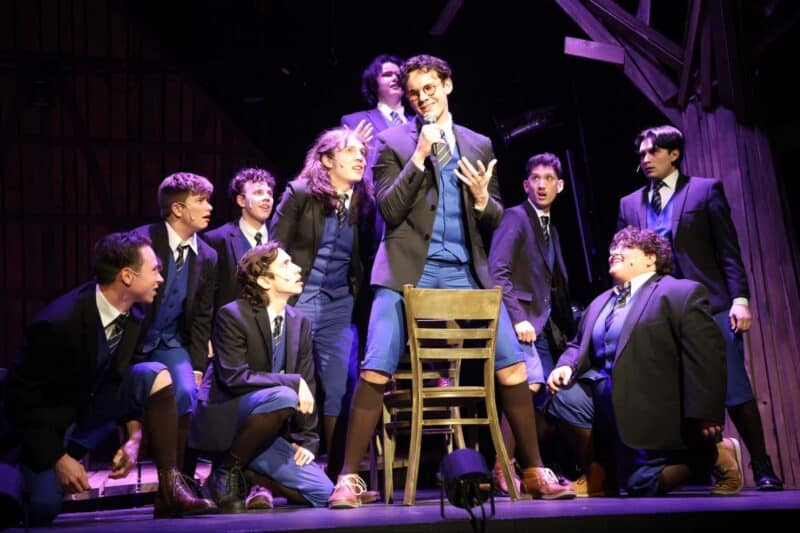
Photo Credit: Dennis Wick Photography
1. Plot Motion in Extractable Songs
Each time that a song occurs in Spring Awakening, they do so as folk/rock concerts within the minds of the repressed teenage characters. Almost every song composer Duncan Sheik and lyricist/bookwriter Steven Sater wrote can be extracted from the show, which is to say they can be enjoyed outside of the musical without having to know anything about the whole plot. They rarely rely on using musical motifs and themes the way someone like Sondheim would (think of the magical bean motif in Into the Woods that pops up whenever the magical beans appear). The songs of Spring Awakening, instead, are mostly based on standalone pop verse-chorus structure, and the lyrics that are either poetic enough to be interpreted broadly and relatably for teenagers of any period.
The upside of this: the songs are inherently accessible, especially to those who don’t listen to more conventional musical theater. The downside of this: the songs rarely move plot forward on their own.
The clever solution? Having very short scenes between sections of songs so that the next set of lyrics comment on the scene you just watched!
Case in Point: “Whispering”
This song takes place halfway through Act II, after teenage girl Wendla is informed that she’s pregnant. The lyrics, at first glance, seem like a random assortment of images:
“Mystery
Home alone on a school night
Harvest moon over the blue land
Summer longing on the wind”
It’s only with the micro-scenes before each chorus (the parents of the boy that impregnated her arguing about the pregnancy) that the lyrics get anchored to the story. With the micro-scenes doing the work of moving plot forward, the songs can have the lyrical freedom to be extractable.
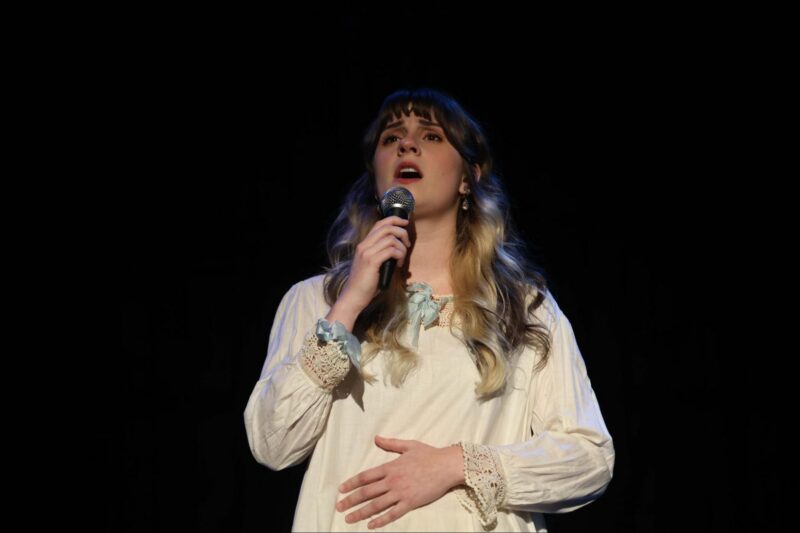
Photo Credit: Dennis Wick Photography
Lesson Learned: A good song that doesn’t directly move plot forward on its own can still work inside a show if the dialogue happening between sections of the song does that work.
2. Oblique Lyrics
If you didn’t know anything about the show and just listened through the Spring Awakening cast recording, could you describe the plot? Probably not. You wouldn’t know that it’s set in 1800s Germany, or the actions of most of the characters, or even most of their names.
You’d probably pick up on the hormonal teenager element though.
But when I first heard these lyrics from the song “The Word of Your Body,” what was literally happening for these characters (where they are and what they’re doing physically) was very unclear to me:
“Don't feel a thing, you wish
Grasping at pearls with my fingertips
Holding her hand like some little tease
Haven't you heard the word of my wanting?

Oh, I'm gonna be wounded
Oh, I'm gonna be your wound
Oh, I'm gonna bruise you
Oh, you're gonna be my bruise”
I think of this writing as “oblique” – indirect, and often poetic, as opposed to the direct writing of someone like Andrew Lloyd Webber, who has characters sing about what they’re thinking plainly or doing quite literally. Take these lyrics from “Poor, Poor Joseph” from Joseph and the Amazing Technicolor Coat as an example of more direct writing:
Narrator: "When some Ishmaelites, a hairy crew, came riding by.
In a flash the brothers changed their plan."
Brothers: "We need cash. Let's sell him if we can."
Andrew Lloyd Webber wants to make sure that there is no confusion about what’s happening in the story of Joseph. Sheik and Sater, meanwhile, don’t feel their lyrics need to do that style of storytelling.
Both styles of writing are useful in different ways, but Spring Awakening is one of the only shows I can think of that embraces oblique writing so consistently. The disadvantage is that it easily confuses audiences, but it has two big advantages. One, it allows you to touch on difficult subject matters without becoming comical, and two, the lyrics are less likely to wear out their welcome upon repeated listening.
Case in Point: “The Word of Your Body”
This mid-Act I ballad is sung when teenagers Melchior and Wendla sit together in the forest, watching the clouds as they experience nervous teenage attraction to each other.
A more direct lyrical approach would have meant describing the forest, or how nervous they are, and could have easily turned into a cutesy “teenagers having a crush” song. Instead, the gentle, otherworldly musical texture contrasted with the abstract, even violent lyrics (“Oh, you’re gonna be wounded/Oh, you’re gonna be my wound”) makes for a listening experience that wasn’t comedic and became richer for me as I listened to it over and over rather than wearing out its welcome.
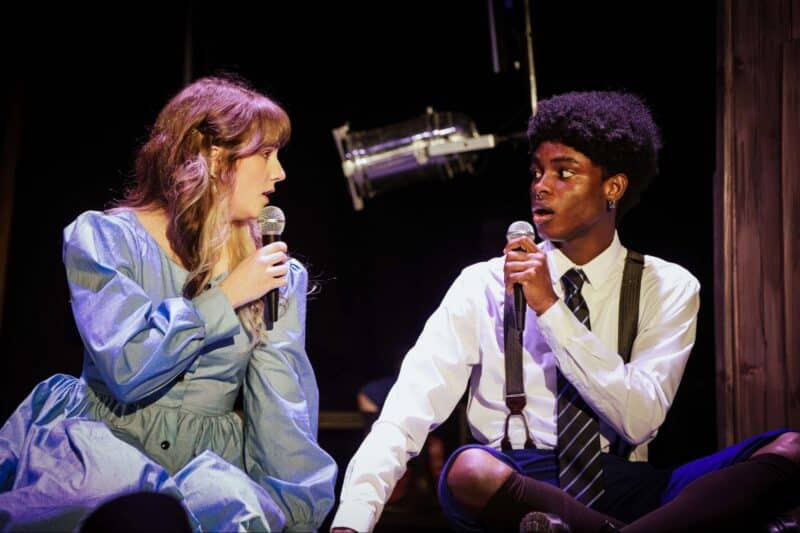
Photo Credit: Dennis Wick Photography
Lesson Learned: Abstract or poetic lyrics that don’t directly describe what the characters are doing or thinking can make for a richer listening experience.
3. When Do I Clap?
When I first saw Spring Awakening, something that struck me as strange was how songs ended. Years later, as I music directed it, I realized that the songs often ended in ways that were typical of pop/rock but not of musical theater, and it often left audiences confused about when to clap – a dangerous thing for musical theater audiences that want to demonstrate their appreciation.
Most musicals (especially big, hammy ones) end songs with a button (a strong, short note or chord to tell you that the song is done). After applause, these songs usually segue directly into a new scene, allowing for a reset. Spring Awakeningoften does neither. Many of its songs end in an open chord allowed to ring (typical of pop music) and/or conclude and the characters immediately pick up the scene where they were when the song started, giving an unfortunate sense that nothing happened dramatically during the song. Both ways of ending a song tend to bring a major, confused question to the audience’s minds: “When do I clap?”
Case in Point: “My Junk”
In this mid-Act I ensemble number, all the teenagers sing about the rush of teenage attraction. The ensemble vocals rise to a big swell, then we get a big, unresolved chord that ends abruptly. For a pop song, that’s great – tense, interesting, leaves you wanting more. But almost every night, the song would end, and there would be a solid few seconds where there was no applause and the audience clearly thinking, “Wait, is that it? Is it over? Do I clap now?”
It’s very likely that Sheik and Sater made that choice intentionally. But when a song doesn’t end in a way that definitively tells the audience that it’s time to applaud, like a button or the end of the scene, they’ll get confused, and a confused audience will disengage from the show.
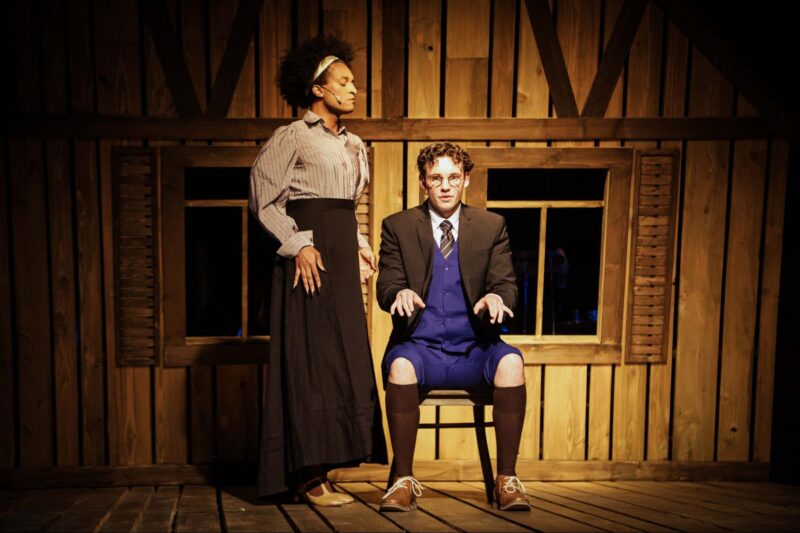
Photo Credit: Dennis Wick Photography
Lesson Learned: To avoid audience confusion and disengagement, ensure that there is a clear way for the audience to know it’s time to applaud.
4. Easy Accompaniment
When I first picked up the piano/vocal score for this show, I was shocked by how easy so much of it was. Admittedly, that’s because so much of it is a piano reduction of a guitar part, which meant much of the score spent time repeating a small group of tightly voiced chords. The reason aside, I was happy to be music directing a show where the accompaniment wouldn’t be yet another huge source of stress on top of everything else.
The show has many interesting musical textures and effects, but rather than achieving them through big, complicated accompaniment, it achieves them through chord choices, the intricate vocal writing, and the instrumental parts of the show’s full orchestration. It reminded me that you can achieve a lot with a little, as long as the choices you make are distinctive enough.
Case in Point: “The Song of Purple Summer”
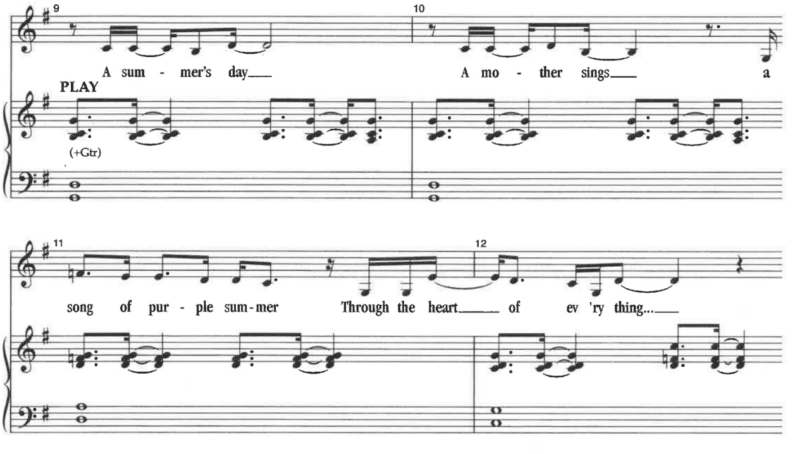
This finale of the show is full of whole notes and repeated chords. Almost all of the complicated counter melodies that I would expect to find in a keyboard’s part are dispersed throughout the strings. What makes this otherwise very easy accompaniment distinctive is the chords, which mostly shift between chords found in G major and those found in Bb major. These distinctive chord combinations mean that the accompaniment is powerful and easily identifiable without being a source of stress – which made me, as the music director, veryhappy.
As a writer, it’s a reminder that I don’t need to worry about complicated sixteenth note sextuplets or using the whole range of the piano the way I often do.
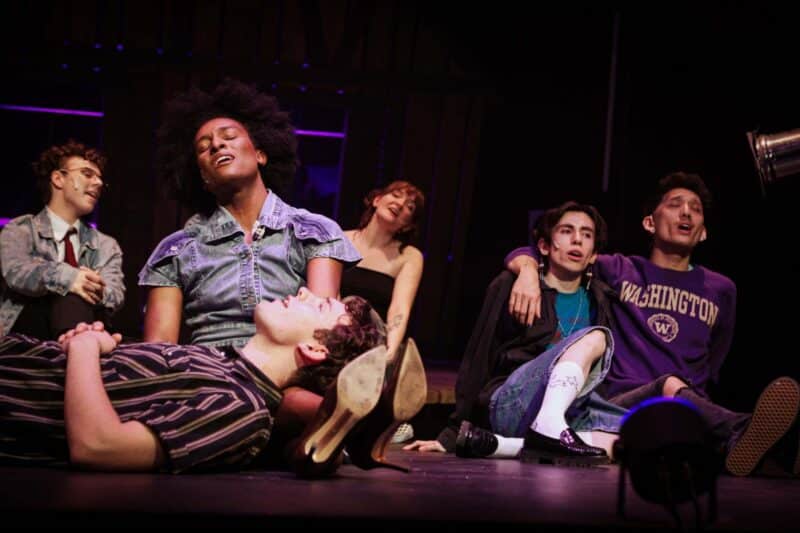
Photo Credit: Dennis Wick Photography
Lesson Learned: Distinctive, simple choices can get you far while asking your musicians to do so much less.
5. Prolonged Passion
Musical theater is a funny art. It’s not like print or recorded media, where, once it’s created, it’s permanent. In order for a musical to survive, it has to be resurrected again and again, by the complete cast and crew, with an audience, night after night across a run, in theater after theater, for as long as possible.
Even in just our one-month run of this show, we gathered up to 30 people with kids, full-time jobs, or school obligations in one room night after night, for two months of rehearsals and four weekends of shows. Add on the crew, the band, the box office staff, and the audience itself, and you’ve got an insane amount of humans gathering for something that is gone as soon as the run is done. Bringing together people willing to put time and energy into Spring Awakening, however, was unexpectedly easy.
So many cast members and crew had lived through events echoed in the show’s plot, or felt that – with rising threats to sexual health education and the alienation of youth – the story needed to be told. There was a deep well of passion for the work and the themes that sustained everyone through the process, and shows survive on exactly this kind of prolonged passion from the community that puts them on.
The show doesn’t need to just invoke that passion for the one night any given audience member sees the show. It needs to invoke that passion from the entire cast and crew for the entire rehearsal and run.
That’s a long time, and it’s a reminder to me as a writer to thoroughly interrogate my own work and ask, “If I weren’t the writer and were asked to go through a two-month rehearsal process and four-weekends to music direct it, would I be excited to do so?”
If I wouldn’t be, others probably won’t be either.
Case in Point: “Mama Who Bore Me (Reprise)”
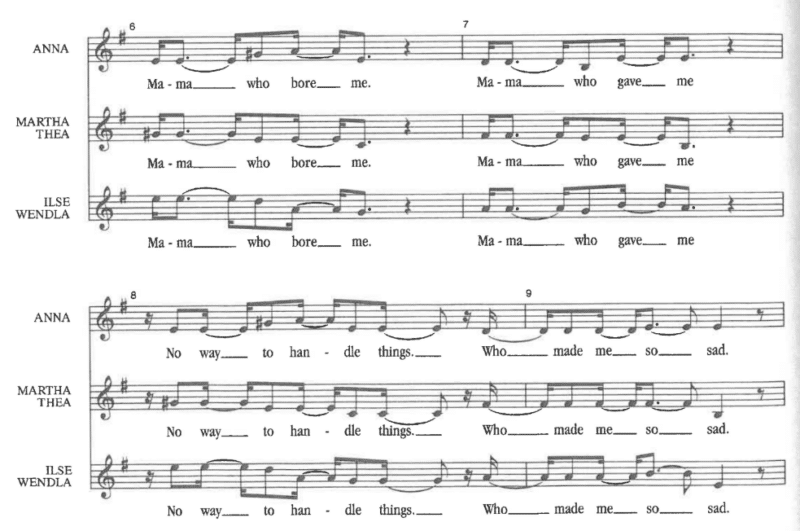
The three (and sometimes more) part harmony of the first group number of the show is fiendishly difficult. The melody requires high belting, the harmonies cross over one another, and there are many unexpected, unintuitive leaps in the lines. If this show didn’t exist and someone brought this song to me for feedback, I would say, “Actors will struggle with these parts, and the more they struggle, the less likely they’ll sustain energy and excitement learning it.” However, I was proved very wrong.
The actors came in so excited to tackle these lines despite their difficulty. It was still a process of layering on the parts with confidence, but the cast put in time and energy both in and outside rehearsal, determined to nail the parts in this song they loved. Where I would have thought musical difficulty and a long learning process would have worn the actors down, their love for the material sustained them.
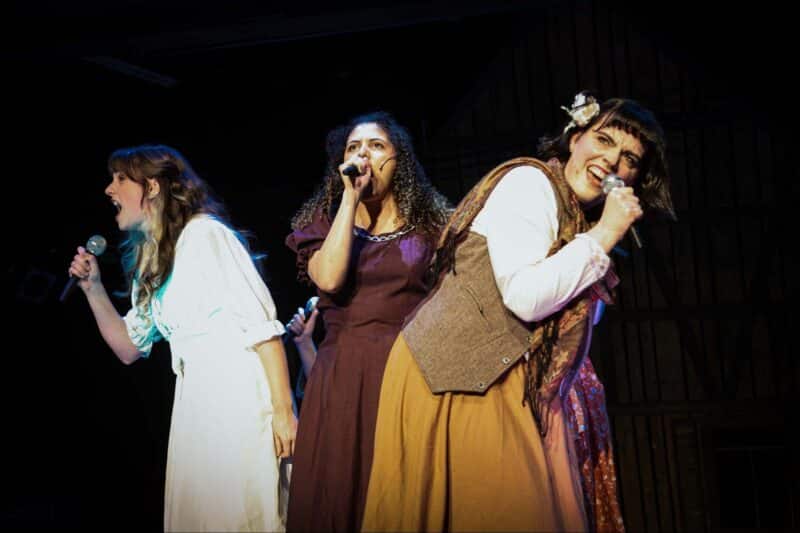
Photo Credit: Dennis Wick Photography
Lesson Learned: We as musical writers have to remember that a show doesn’t need to just excite audiences, or other writers, but potential cast and crew in a way that they’d be willing to put a huge amount of energy into the show for quite a long time.
Final Takeaways
Spring Awakening won eight Tony Awards, including for Best Musical, Direction, Book, Score and Featured Actor, as well as four Drama Desk Awards and a GRAMMY Award for the original cast album. It’s thematically relevant as sexual education continues to be threatened, is hugely popular with audiences and actors, and remains full of beautiful music with some really gorgeous string writing.
Could I ever write a show like it? Probably not. So much of its musical and storytelling style is foreign to me. That’s exactly why I’m so glad I music directed it. Helping to bring this show to life immersed me in a way of thinking about musical theater I wouldn’t of my own accord, and I hope that every musical theater writer gets a chance to learn from work unlike their own the way that I did.
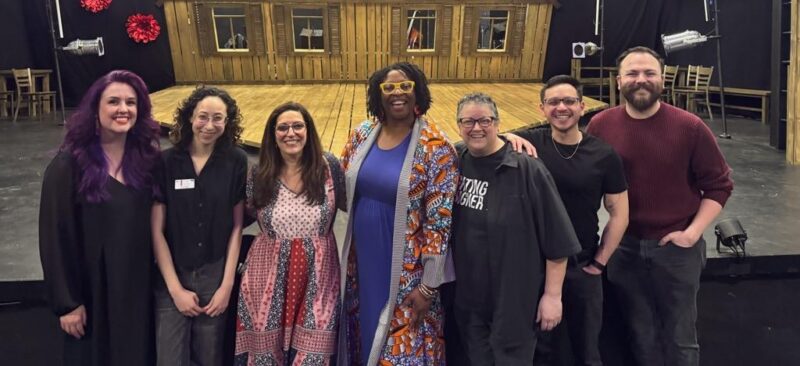
Daniel Wolfert with the creative team of Spring Awakening
Bonus Content
Fun fact – this article started as an Instagram post…
…and a TikTok!
If you like what you see, give me a follow for more musical theater writing adventures!
 Daniel Wolfert (he/him) is an award-winning Seattle area musical theater songwriter with a flair for infectious melodies and dynamic ensemble writing. His music has been selected for performance at the Green Room 42 and won the Performer’s Pick Award at the 2024 and 2025 Musical Writers Festivals, and his one act musical Hijinx & Sue was selected for production by Bite Sized Broadway in 2023. Alongside composing, he music directs in Seattle area theaters and produces demos for other musical theater songwriters. He is always looking for new collaborators and new ways to create musical theater that will excite future generations of actors, music directors, and audiences.